
10 Winter Hairstyles That Reduce Frizz, Static, and Hat Hair
Cold air outside and dry heat indoors pull moisture out of your hair, and a wool hat finishes the job. The right winter hairstyles that reduce frizz can help by keeping strands together, tucking the ends out of the way, and cutting down on rubbing. No style erases frizz completely, but some make it far less noticeable.
This guide explains why winter hair acts up, how to tell static from frizz from breakage, and ten styles with steps, timing, and limits. It also covers a safety point many winter hairstyle lists skip: tight styles can pull on your scalp, so you’ll see how to keep tension low, based on dermatologist guidance.
Why Your Hair Acts Up in Winter (It Isn’t Always Frizz)
Winter hair trouble usually comes from two things at once: dryness and rubbing. Knowing which one is hitting your hair makes it easier to pick a style that helps.
Dry air, indoor heat, and the moisture swing
Hair takes on and gives off moisture depending on the air around it. Winter air outdoors holds little moisture, and indoor heating dries it out even more. You move between the two all day, so your hair rarely stays hydrated.
Dermatologists at Cleveland Clinic link winter static to much drier air and hair that can’t hold enough moisture. They also note that product buildup, such as silicone, can change how well hair takes in moisture. If your hair feels coated but still dry, buildup may be part of the problem.
Static, friction, and flyaways
Static happens when dry strands rub against fabric and pick up an electric charge. The strands then push away from each other and stand up. That is why your hair often looks fine in the mirror, then lifts and crackles the moment you pull off a beanie.
Rubbing also roughens the cuticle, the outer layer of tiny overlapping scales that cover each strand. A rough cuticle makes hair look fuzzy and tangle more easily. Knit hats, wool scarves, and coat collars all create this kind of friction.
Frizz, static, or breakage? How to tell
These three problems overlap, but each has a different look:
- Frizz: a puffy, fuzzy halo, often along the surface or ends of the hair.
- Static: strands that lift, cling to your face, or stand up right after a hat or sweater comes off.
- Breakage: short, snapped pieces, split ends, and hair that seems stuck at one length.
Most of the styles below help with frizz and static. Breakage also needs gentle handling, which we cover later. If you notice broken hairs along your hairline or a sore scalp, see a dermatologist.
What Makes a Hairstyle Work Against Winter Frizz
You can judge almost any style with three questions: Does it reduce rubbing? Does it keep the ends covered or tucked? Is it loose enough to be safe?
Less rubbing, fewer exposed ends
Hair that hangs loose touches every scarf, collar, and hood. Gathering it into a braid, bun, or low ponytail means fewer strands rub on fabric. Tucking the ends matters too, because ends are the oldest, driest part of the hair and the first to fray.
Low tension is the safety rule
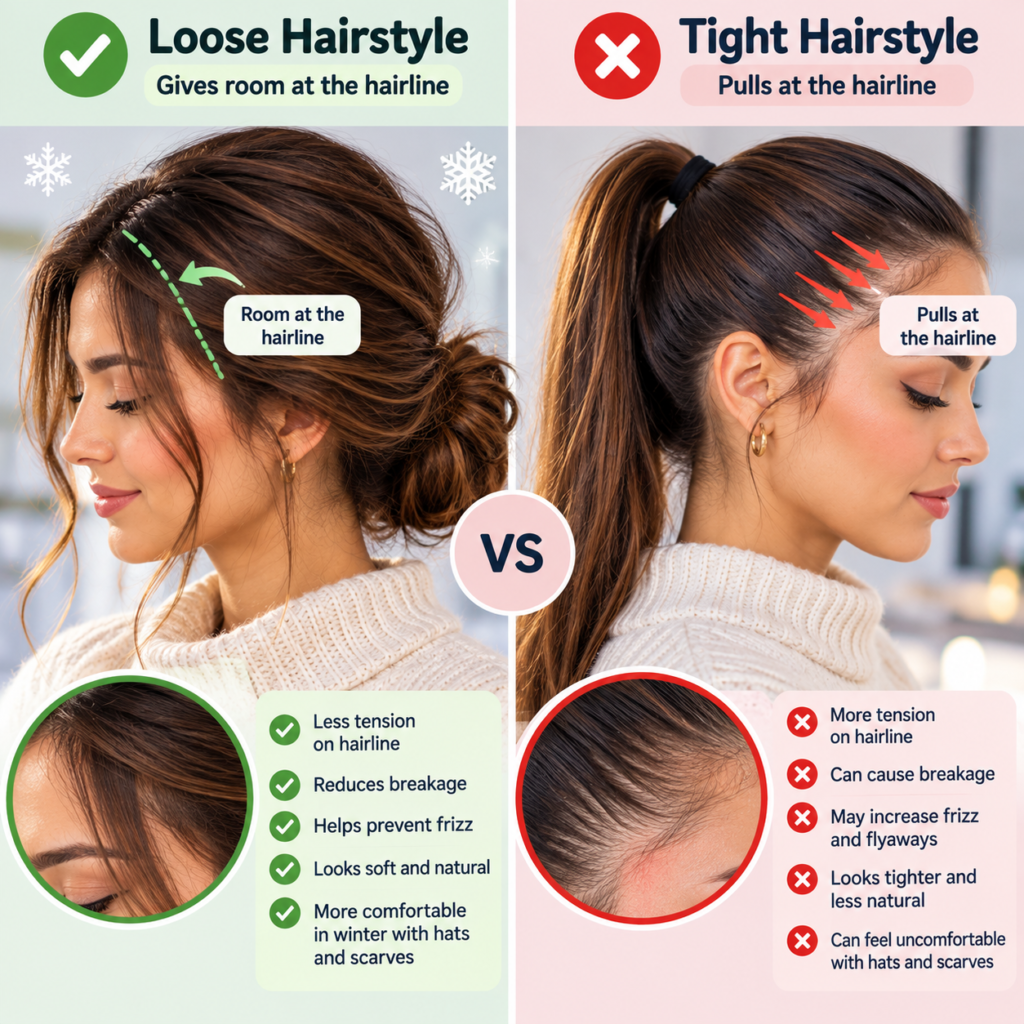
Many “protective” winter styles pull on the scalp. Over time, repeated pulling can cause traction alopecia, a type of hair loss. The American Academy of Dermatology (AAD) says tightly pulled ponytails, buns, braids, and updos can lead to hair loss, and that your hairline is often the first place it shows.
A few practical rules from that guidance:
- If a style feels painful or tight, it is too tight. Loosen it.
- Loosen braids, especially around the hairline.
- Change styles regularly so the same spots do not take the strain every day.
- If you wear a hat or head covering, pull your hair back loosely first. The AAD notes that a covering rubbing over tightly pulled hair can add to the problem, and that silk or satin coverings are gentler than other fabrics.
- If you wear braids for a longer stretch, the AAD suggests no more than 6 to 8 weeks.
Cleveland Clinic’s dermatologists add a point about buns. Each strand folds at several points in a bun, so a tight one can cause breakage. They also advise skipping thin rubber bands in favor of soft fabric hair ties.
Styles that survive hat on, hat off
Winter styling has to work twice: once under a hat, and again when the hat comes off. Styles with fewer sections to flatten, like a low bun or loose braid, bounce back more easily. You’ll find a quick reset routine in the hat section below.
Pick a Style by the Problem You Have
Use this as a shortcut, then read the full steps for the styles that fit.
| Your winter problem | Try this style | Why it can help |
|---|---|---|
| Static after taking off a hat | Loose low bun, twisted low ponytail | Gathers hair and keeps it off collars |
| Dry, frizzy ends | Loose low braid, bun with tucked ends | Keeps ends covered and out of friction |
| Flat roots after a hat | Half-up twist, hat-ready waves | Leaves the crown less compressed |
| Dry curls or coils | Flat twists, satin-secured puff | Low handling and less contact with fabric |
| Short hair that flies away | Tucked bob, clip-back style | Contains the shortest pieces |
For other fast options on rushed days, our guide to quick hairstyles for busy mornings has more ideas.
10 Winter Hairstyles That Reduce Frizz
Time estimates are rough. They assume dry, detangled hair and a bit of practice. Yours may differ. For every style, use a gentle detangling method first, and keep the hold light.
1. Loose Low Bun
Hair types: straight, wavy, curly · Lengths: medium to long · Difficulty: easy · About 2–4 minutes · Hat-friendly: yes · Protects ends: yes
A low bun gathers your hair at the nape, away from coat collars and scarves. Because the ends are wrapped inside, they get less rubbing.
- Smooth a small amount of leave-in cream or light oil over the lengths, focusing on the ends.
- Gather hair at the nape with a soft fabric hair tie, leaving room to slide a finger under it.
- Twist the ponytail loosely and wrap it around the base.
- Tuck the ends under and pin with two or three pins.
Tip: Pin gently. Pins pushed tight against the scalp add tension. Common mistake: pulling the ponytail tight before wrapping. Make it last: a drop of cream on your palms smooths flyaways at the crown. Not ideal when: your hair is very heavy or fine and slippery. A heavy bun can drag, and fine hair may need an extra pin.
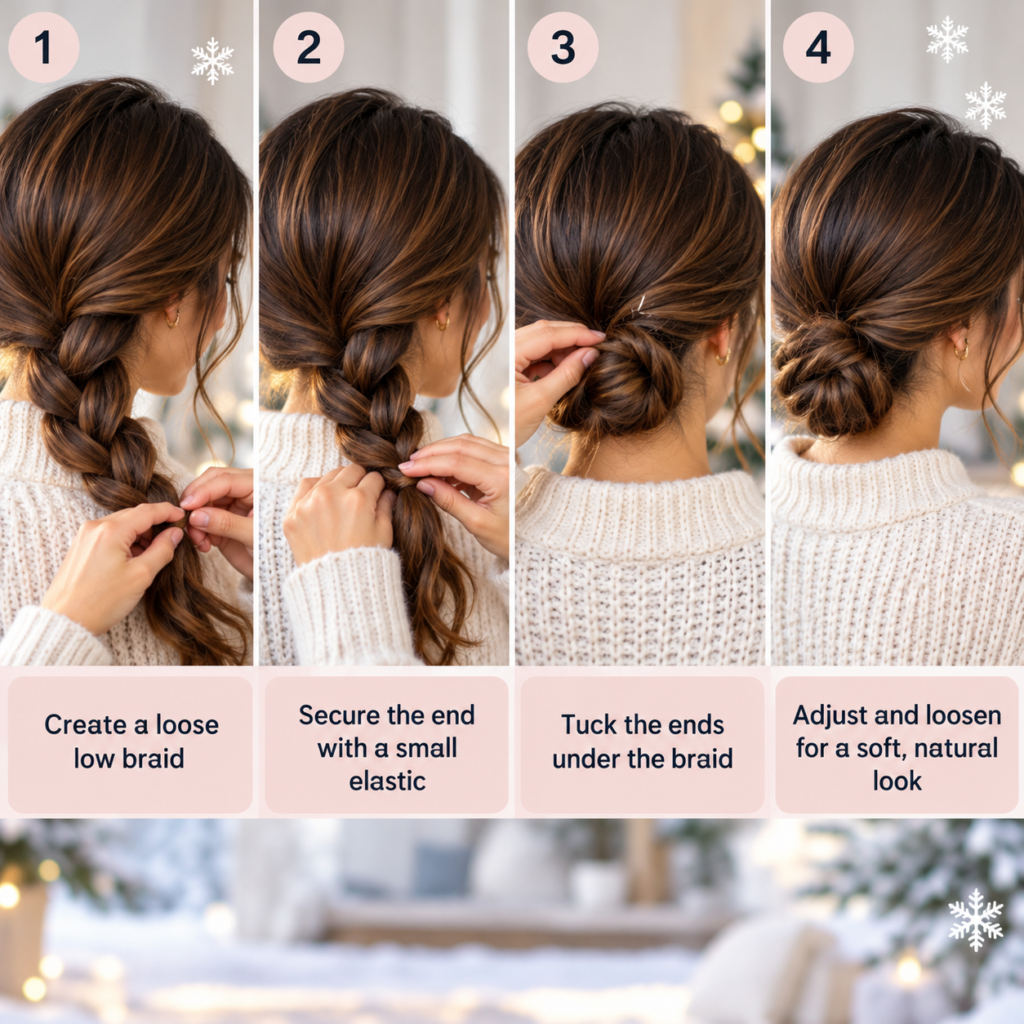
2. Loose Low Braid
Hair types: all textures · Lengths: medium to long · Difficulty: easy to moderate · About 4–8 minutes · Hat-friendly: yes · Protects ends: yes, if wrapped or tucked
A single braid keeps strands from rubbing against each other and against fabric. A French or Dutch braid also covers flyaways along the top.
- Apply a light leave-in, then detangle gently.
- Braid from the nape or crown, keeping each section relaxed.
- Stop a few inches from the end and secure with a soft tie.
- Wrap the braid into a low coil, or tuck the end into your collar.
Tip: After braiding, gently tug a few strands out near the hairline so the base does not pull. Common mistake: braiding tightly “so it lasts.” Make it last: keep the braid thick and soft. Not ideal when: you plan to wear it several days in a row without loosening it. Give your scalp a break between tight sessions.
3. Twisted Low Ponytail
Hair types: straight, wavy · Lengths: medium to long · Difficulty: easy · About 3–5 minutes · Hat-friendly: yes · Protects ends: partly
Twisting two sections around each other adds structure without a full braid. It works well for people who deal with static in heated offices.
- Part your hair down the middle.
- Twist each half away from your face.
- Twist the two halves around each other.
- Secure the end with a soft tie.
Tip: Leave the tie slightly loose. Common mistake: twisting too tightly at the roots. Make it last: a light anti-frizz cream on the ends. Not ideal when: you have very short layers that slip out of the twist.
4. Half-Up Twist or Half-Up Bun
Hair types: most, including fine and thick · Lengths: medium to long · Difficulty: easy · About 2–3 minutes · Hat-friendly: yes · Protects ends: only the lengths you leave loose are exposed
Pulling back the top section keeps the front and crown flat, where flyaways show most. The hair below stays loose and softer around your face.
- Section off hair from the crown to just above your ears.
- Twist it back and secure it with a clip or pins, or tie it into a small bun.
- Smooth the loose lengths with a little leave-in.
Tip: Use a clip with wide teeth instead of a thin elastic. Common mistake: pulling the top section tight against the scalp. Make it last: rub a tiny bit of cream between your palms and press over the top. Not ideal when: you want maximum protection. The loose lower half still rubs on scarves.
5. Sleek Low Ponytail With Light Tension
Hair types: straight, wavy, and smooth curls · Lengths: medium to long · Difficulty: easy · About 3–5 minutes · Hat-friendly: yes · Protects ends: partly
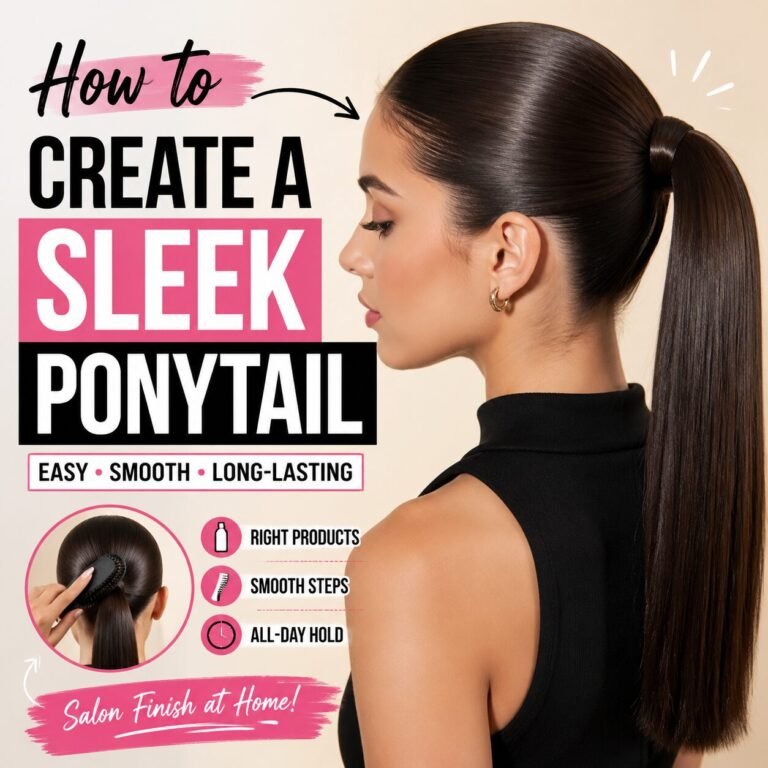
A sleek low pony looks polished and fits easily under a hat. Sleek styles also show flyaways more, so smoothing and a gentle hold matter. For the full technique, see our guide on how to create a sleek ponytail.
- Apply a lightweight smoothing cream or serum to damp-dry hair.
- Brush upward with a soft brush.
- Secure low at the nape with a fabric-covered tie.
- Wrap a small piece of hair around the tie and pin.
Tip: Keep the hold firm enough to look neat, but never to the point of feeling a pull. Common mistake: brushing dry hair hard to get it smooth, which can lift the cuticle. Make it last: keep a small comb and a hair clip in your bag. Not ideal when: you have a sensitive hairline or recently wore tight styles.
6. Soft Romantic Updo or ’90s-Style Twist-Up
Hair types: most · Lengths: medium to long · Difficulty: moderate · About 6–10 minutes · Hat-friendly: with a roomy hat · Protects ends: yes
Looser updos are popular this season, and their slightly undone finish hides flyaways rather than fighting them. Think a twisted knot with a few loose strands.
- Smooth lengths with a light leave-in.
- Twist all your hair into one loose rope.
- Fold it up and pin it, tucking the ends under.
- Pull out a few pieces near your face for a soft finish.
Tip: Use wide, smooth pins and spread them out. Common mistake: placing many pins in the same spot. Make it last: tuck pins at different angles. Not ideal when: you will be wearing a snug hat all day, since the pins can press into your scalp.
7. Flat Twists or Two-Strand Twists (Curly and Coily Hair)
Hair types: curly and coily · Lengths: short to long · Difficulty: moderate · About 20–60 minutes, depending on size · Hat-friendly: yes · Protects ends: yes, if the ends are tucked into the twist
Low-manipulation styles reduce daily handling. For curly and coily hair, that matters. The AAD says curly and coily hair is more prone to dryness and breakage, so less daily combing can help.
- Start on clean, well-moisturized, detangled hair.
- Work in small, even sections with a leave-in conditioner.
- Twist loosely from root to end.
- Seal the ends with a light cream or oil.
Tip: Choose slightly thicker twists. The AAD recommends thicker braids and locs over thin ones. Common mistake: twisting tightly at the hairline. Make it last: wrap a satin scarf at night. Not ideal when: your scalp feels sore or itchy. Take them down if that happens.
8. Satin-Secured Puff or Pineapple
Hair types: curly and coily · Lengths: medium to long · Difficulty: easy · About 3–5 minutes · Hat-friendly: yes · Protects ends: yes
Gathering curls loosely at the top of the head keeps the curl pattern from being crushed under a hat. A satin scrunchie or scarf adds a smooth surface.
- Flip your head over and gather curls loosely near the crown.
- Secure with a wide satin scrunchie, leaving the curls loose and soft.
- If you want more coverage, tie a silk or satin scarf around the base without pulling it tight.
Tip: Keep the puff high and roomy. Common mistake: using a thin elastic that creates dents and snaps hair. Make it last: refresh with water mist on palms, then scrunch. Not ideal when: a tight hat will crush the shape. Try twists or a low puff instead.
9. Smooth Short Styles: Tucked Bob, Bixie, or Clip-Back
Hair types: all · Lengths: short · Difficulty: easy · About 3–5 minutes · Hat-friendly: yes · Protects ends: ends are short, so friction is mostly at the nape and sides
Short hair does not rub on a scarf as much, but it still picks up static from a hat. Tucking the sides behind your ears and clipping the front keeps pieces under control.
- Apply a pea-sized amount of smoothing cream to damp hair, then air dry or dry on low heat.
- Tuck the sides behind your ears.
- Clip the front back with a smooth barrette or use a headband.
Tip: A headband with a soft, wide band is gentler than a thin metal one. Common mistake: over-brushing, which charges strands with static. Make it last: wipe your palms with leave-in and press over the top. Not ideal when: your hair is very layered and pieces slip out of clips.
10. Hat-Ready Waves
Hair types: straight, wavy · Lengths: medium to long · Difficulty: moderate · About 15–25 minutes plus drying time · Hat-friendly: yes, with a roomy hat · Protects ends: no
Some people just want to leave their hair down. Waves hide flyaways well, but loose hair takes the most friction, so be honest about the trade-off.
- Let hair dry completely before leaving the house.
- Create loose waves by braiding damp hair overnight or using a low-heat tool with a heat protectant.
- Break up the waves with your fingers.
- Smooth ends with a light oil or leave-in.
Tip: Choose a hat with a smooth lining if you can. Common mistake: pulling a tight beanie over hair that is still damp. Make it last: finish with a tiny amount of anti-static spray. Not ideal when: you will be outside for a long time in wind. A braid or low bun protects better.
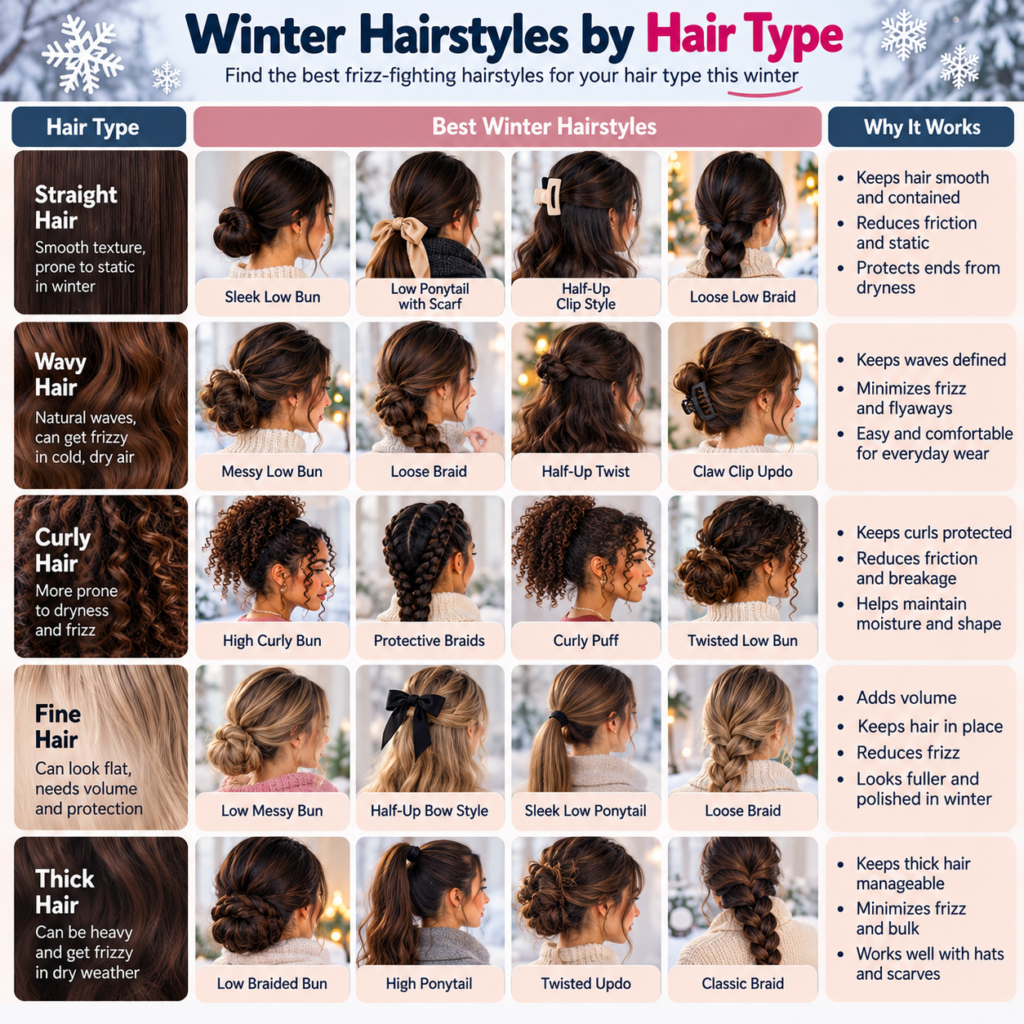
Best Winter Hairstyles by Hair Type and Length
You do not have to follow all ten styles. Use these notes to narrow down.
Straight hair
Straight hair shows static the most, because strands slide easily against fabric. Smooth, tucked styles like the low bun or twisted ponytail tend to work best.
Wavy hair
Waves frizz when you handle them too much. Try a loose braid or half-up style, apply product once, and avoid brushing after the style is set.
Curly and coily hair
Curly and coily hair is drier by nature, and the AAD says washing it too often can leave it dry and frizzy. Twists, satin-secured puffs, and loose braids reduce handling. Detangle only when hair is wet and coated with conditioner, using fingers or a wide-tooth comb.
Fine or thin hair
Heavy or tight styles can flatten fine hair under a hat and may stress the strands. Half-up styles and low, loose buns keep volume at the crown. For more ideas, see our list of the best hairstyles for thin hair.
Thick hair
Thick hair holds a lot of weight, which adds tension to any style. Work in sections, use more than one gentle tie or clip, and choose looser styles.
Short, medium, and long hair
- Short: use clips and headbands to contain flyaways, and expect static from hats.
- Medium: this length slides under scarves easily. Half-up styles and low ponytails are good fits.
- Long: the ends take the most wear, so braid, coil, or tuck them.
How to Wear These Styles Under Hats, Scarves, and Coats
Most winter frizz shows up in the first minute after you take off your outerwear. A little planning helps.
Before you head out
- Make sure your hair is fully dry. Hats press damp hair flat, and it dries in the shape of the hat.
- Smooth a small amount of leave-in cream on the ends.
- Keep the style loose enough that the hat does not squeeze it against your scalp.
Choosing and wearing the hat
Wool and rough knits create the most friction. The AAD says silk or satin head coverings are gentler on hair than other materials. A smooth lining may reduce rubbing, though hat linings have not been studied as closely, so treat them as a helpful extra rather than a fix.
Pull the hat on and off gently instead of dragging it across your head. Wash the lining or scarf now and then, since oil and product can build up on fabric.
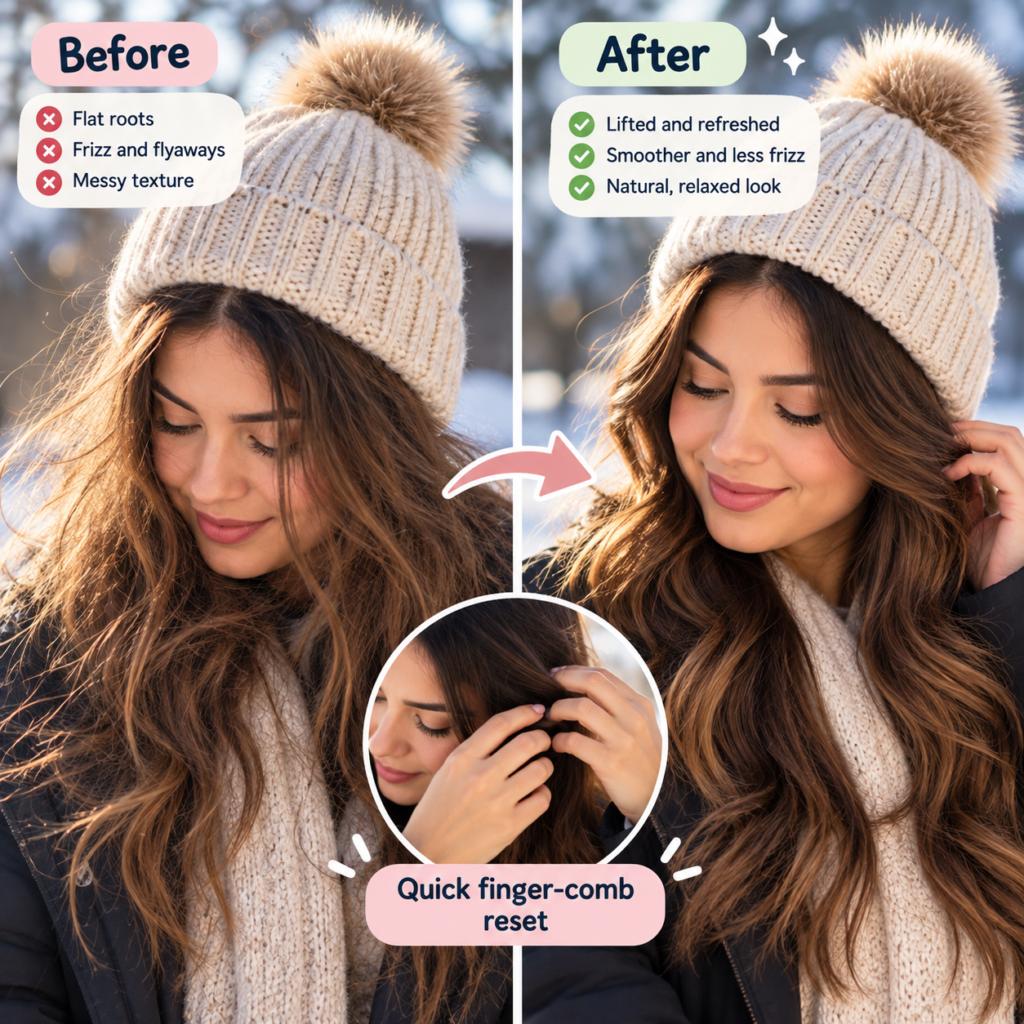
The 30-second hat-off reset
- Lift the hat straight up and off.
- Run your fingers through the top and sides to separate strands.
- Rub a tiny bit of leave-in or a few drops of water between your palms and press lightly over flyaways.
- Re-pin or re-tie anything that moved.
Scarves and collars
A wool scarf rubs on the back of your hair all day. Styles that lift hair off the neck, like a bun or braid, avoid most of that. If you wear your hair down, tuck it under the scarf instead of letting it drag.
How to Make Your Style Last Through a Winter Day
Cold commutes, heated offices, and a hat on and off can wear down any style by lunchtime. A few habits keep it neat:
- Start with fully dry hair and a light layer of product.
- Use soft ties and wide clips that grip without pulling.
- Touch your hair less. Hands add oils and static.
- Keep a small comb and a clip in your bag for a quick fix.
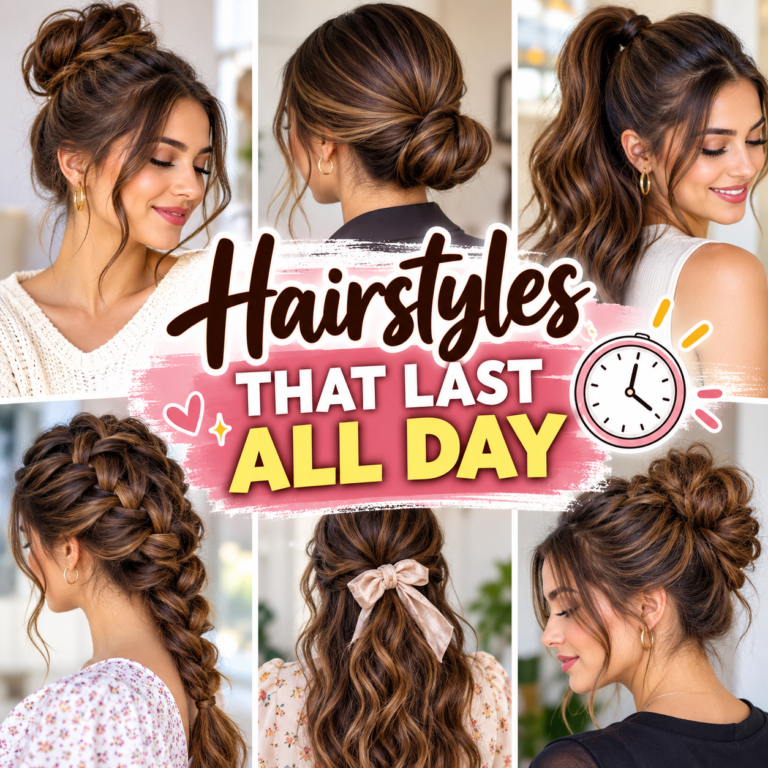
For more ideas on keeping a look neat from morning to night, read our guide to hairstyles that last all day.
Winter Styling Mistakes That Make Frizz Worse
- Brushing dry, frizzy hair hard. It lifts the cuticle and can stretch hair.
- Tight ties, braids, and buns. They can break hair and strain the scalp.
- High heat. Cleveland Clinic’s dermatologist advice favors air drying and skipping hot tools when you can.
- Harsh, frequent shampooing. It can strip moisture from already dry hair.
- Heavy product layers. Buildup can make hair feel coated yet dry.
- Skipping trims. Split ends look frizzier and can travel up the strand.
- Leaving home with damp hair under a hat. The hat flattens it, and the scalp stays damp under fabric.
Winter Hair Care That Helps These Styles Work
Hairstyles help, but moisture does most of the work.
Washing and drying
How often to wash depends on your scalp and texture. Cleveland Clinic’s guidance says it should depend on how oily your scalp gets. For curly hair, the AAD says it does not need daily washing. Pat hair dry with a microfiber towel or soft cotton shirt instead of rubbing, and let it air dry when you can.
Moisture and products
A conditioner for your hair type, a leave-in conditioner, and an occasional deep conditioner can help hair hold moisture and reduce static. Use light products on fine hair and richer ones on thick or coily hair. If your hair feels coated, a clarifying wash now and then can reduce buildup.
Trims and indoor air
Regular trims remove damaged ends. Around every six weeks is one common suggestion, but ask your stylist what your hair needs. Some people also like a humidifier in the bedroom, though evidence for hair specifically is limited.
Winter 2026–27 Hair Trends That Pair Well With Frizz Control
Stylists quoted in this fall’s trend coverage keep returning to a few looks. According to Who What Wear, Hershesons stylist Nataliia Bumford says the ’90s updo is back and simpler than before, and that layered cuts are leaning toward a stronger outline with softer face-framing pieces. Refinery29’s fall roundup highlights the shaggy bob, the bixie, and softer bangs. Rush Hair’s autumn/winter guide names glass hair, sculptural chignons, and romantic waves.
How do these fit with frizz control?
- Soft updos and chignons double as low-friction winter styles.
- Mid-length and bob cuts slip under scarves without much rubbing.
- Glass hair looks best with smooth cuticles, but a high-shine finish also shows every flyaway. Keep moisture up and skip it on very staticky days.
- Lived-in waves hide flyaways but leave hair loose, so use a hat-off reset.
Trends change quickly, so treat these as ideas rather than rules.
Frequently Asked Questions
Why is my hair so frizzy in winter?
Dry outdoor air and indoor heat pull moisture from your hair, and hats and scarves add friction. Static and frizz can happen at the same time. Moisturizing, drying gently, and choosing low-friction styles can help.
What is the best hairstyle for frizzy hair in winter?
There is no single best style. A loose low bun, low braid, or twisted ponytail are good low-friction choices for many people. Curly and coily hair often does well in twists or a satin-secured puff.
How do I stop static hair when I take off my hat?
Start with fully dry, moisturized hair. A smooth hat lining may help. When you take the hat off, run your fingers through your hair and press a tiny bit of leave-in or water over flyaways.
Are braids good for winter hair?
They can be. Braids reduce rubbing and keep the ends contained, but only if they are loose, especially at the hairline. The AAD says tight braids can lead to hair loss and suggests wearing braids for no longer than 6 to 8 weeks.
Should I go outside with wet hair in winter?
It is better not to. A hat presses damp hair flat, and a damp scalp under fabric is uncomfortable. Dry your hair fully first, using a low-heat setting if you need to.
Do satin or silk-lined hats help with frizz?
They may. The AAD says silk or satin head coverings are gentler on hair than other materials. Hat-specific research is limited, so consider a lining a sensible extra, not a guarantee.
Can a haircut reduce winter frizz?
Trims remove split ends, which look frizzier. Mid-length cuts and bobs also slide under scarves with less rubbing. A stylist who knows your texture can suggest the best shape.
Choose the Style That Fits Your Winter Day
The best winter hairstyle is the one that keeps your hair covered, loose enough to be comfortable, and easy to refresh when the hat comes off. If you take away one thing, let it be this: reduce rubbing, keep tension low, and match the style to your hair type.
Pick one or two styles from this list and wear them for a week. Notice whether your ends stay smoother and your hairline feels comfortable. Keep what works, and change what does not.